WELCOME TO THE DAIRYMIX MULTI-CRITERIA SUSTAINABILITY ASSESSMENT TOOL
Thank you for using this interactive questionnaire!
This questionnaire is a tool supporting dairy-farmers and farm advisors in evaluating
the
multi-criteria sustainability of crop-livestock systems for dairy production by
collecting
key farm data on dairy herd, feed and production, as well as land use, economic and
work-life balance aspects.
By answering this questionnaire, you will receive insights into an integrated assessment
of
environmental, economic and social sustainability of dairy production.
The tool aggregates sustainability indicators through a fixed hierarchical tree where
weights were assigned based on expert judgement, through structured surveys with specialised
working groups and subsequent consistency checks — meaning that different indicators and
themes (“tree branches”) contribute differently to the final sustainability score.
However,
the three main branches (environmental, economic and social sustainability) have the same
weights.
Before you begin, it is helpful to have an overview of the following:
Herd and milk production – average size of dairy cow herd, average live weight
of cows, milk yield per cow (including fat and protein concentration), age at first
calving and calving interval, breeds present in the herd (crossings included)
Feeding – the main types of feed your cows receive (forages, concentrates,
byproducts), how protein-rich the diet typically is, and how much you rely on purchased
vs. home-grown (or locally-grown) forage or concentrates.
Farm habitats – an approximate understanding of how your farm area is distributed
across crops, permanent grasslands, trees, shrubs, forests, wetlands, and other habitat
types.
Land management – up to four “grassland types” on your farm, with their size,
whether they are mostly mown or grazed, and how intensively they are typically
fertilised or utilised; what percentage of the cultivated land is irrigated; the
cultivated crops and their phytosanitary treatments.
Key economic aspects – the major sources of income and costs linked to your dairy
activity, in terms of farm gross output, farm gross margin, farm net income, farm sales,
subsidies, loan annual loan repayments, annual unpaid work hours and total work hours.
Definitions are given here. Approximate figures are sufficient.
Working conditions – a general sense of workload, labour availability, and how
sustainable the day-to-day situation feels.
The questionnaire takes about 10–15 minutes if you have your numbers ready. Once completed
you can export your results to Excel for further review. We respect your privacy: all data
remain confidential, they are not stored and are used only for this assessment.
Please scroll down and begin by selecting the case study farm of interest:
This tool is provided for educational and demonstrative purposes. It illustrates how
sustainability in dairy farming can be assessed using a multi-criteria approach, but it
does not offer a precise or complete evaluation of any specific farm. The weighting of
themes and indicators is based on expert judgement and structured surveys, and thus
reflects informed but inherently subjective choices rather than universal or objective
values. Accordingly, the results do not constitute professional advice, certification,
or an authoritative sustainability evaluation.
The results should therefore not be used as basis for operational, financial, or
regulatory decisions. Please use the outputs as a learning aid or starting point — not
as a complete assessment for management or compliance purposes. Users remain fully
responsible for how they interpret and apply the outputs. No liability is accepted for
decisions made on the basis of the information produced by this tool.
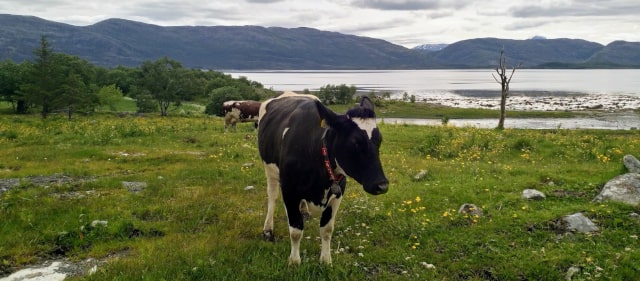
Grass-based dairy farm in
Norway with 30 ha of Utilised Agricultural Area (UAA), a herd of 24 cows, and a stocking
rate of 1.29 LU/ha. Dairy production follows all-year calving and relies entirely on
local grasslands and purchased concentrates, operating with a short grazing season (91
days), no cropland, consistent with the climatic limits of the region. The farm has high
milk yields (>10.000 L/cow per year), and labour is mostly family-based.
Click here to proceed....
Mixed dairy–arable farm in
Northern France operating 103.5 ha of Utilised Agricultural Area (UAA), with 75 cows and
a stocking rate of 1.26 LU/ha. Its land base includes both cropland and grassland, with
grassland covering about 40% of the UAA. The farm has a short grazing period (61 days);
the animal diet relies largely on purchased and farm-produced concentrates. The farm has
very high milk yields (>12.000 L/cow per year), calving is autumn-based, and labour is
mainly family work supplemented with hired help.
Click here to proceed....
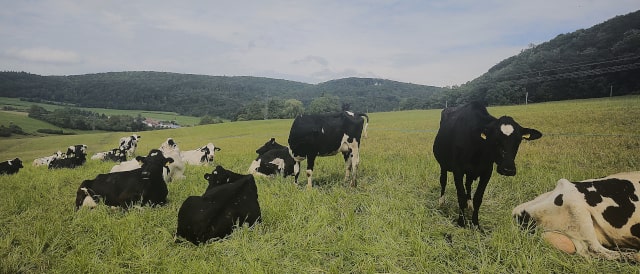
Extensive pasture-based farm
in Central France, managing 161 ha of Utilised Agricultural Area (UAA), which is almost
exclusively grassland, with 73 dairy cows and a stocking rate of 0.77 LU/ha. The animal
diets relies largely on local forages, with long grazing season (206 days), an all-year
calving pattern, moderate milk yields (around 7.000 L/cow per year). Labour is mostly
family-based.
Click here to proceed....
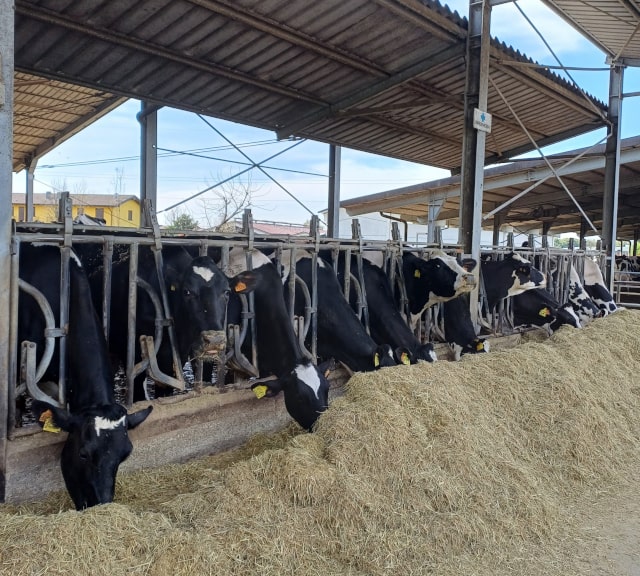
High-productivity dairy farm
in North-Western Germany with 71 ha of Utilised Agricultural Area (UAA), 138 cows, and
stocking rate of 2.57 LU/ha. The UAA is evenly distributed between cropland and
grassland; the animals are housed all year round. The animal diets relies largely on
purchased and farm-produced concentrates. Calving occurs all year round, milk yields are
high (around 11.000 L/cow per year), and the farm relies on both family and paid
labour.
Click here to proceed....
Organic dairy farm in
North-Eastern Germany managing 230 ha, with 110 cows and a stocking rate of 0.55 LU/ha.
It combines grassland with crops typical of organic rotations (including legumes) and
applies no mineral nitrogen. The animal diets relies mostly on locally grown forages,
with a moderate use of concentrates (mostly local). The grazing period is 43 days, and
calving follows an all-year pattern. Milk yields are quite high (around 9.000 L/cow per
year). Labour includes both family and hired workforce.
Click here to proceed....
Pasture-based dairy farm in
Ireland with 89 ha, a herd of 125 cows, and a stocking rate of 2.02 LU/ha. The farm
operates a long grazing season (239 days) and relies mostly on grassland, with a
moderate use of purchased concentrates. The system uses spring calving, typical of Irish
seasonal milk production. Milk yields are fairly high (around 8.000 L/cow per year).
Labour is mostly family work.
Click here to proceed....
• Wilfart, A., Baillet, V., Balaine, L., de Otálora, X. D., Dragoni, F., Krol, D. J., ... & Amon, B. (2023). DEXi-Dairy: an ex post multicriteria tool to assess the sustainability of dairy production systems in various European regions. Agronomy for Sustainable Development, 43(6), 82. https://doi.org/10.1007/s13593-023-00935-3
• Baillet, V., Balaine, L., Díaz De Otálora, X., Rodriguez, D.G.P., Frątczak-Müller, J., Flø, B.E., Amon, B., Alem, H., … & Wilfart, A. (2023) Dexi-Dairy Indicator Handbook—Sustainability Tree and Selected Indicators for Assessing European Specialised Dairy Farms; 2022. https://hal-lara.archives-ouvertes.fr/hal-04139500/
• Aubertot, J. N., & Robin, M. H. (2013). Injury Profile SIMulator, a qualitative aggregative modelling framework to predict crop injury profile as a function of cropping practices, and the abiotic and biotic environment. I. Conceptual bases. PLoS one, 8(9), e73202. https://doi.org/10.1371/journal.pone.0073202
• Khan, A., Shah, D., & Bostock, M. (2023). collapsibleTree: Interactive Collapsible Tree Diagrams using ‘D3. js’ R Package Version 0.1.8.
You must answer in order to proceed...
Average live weight of cows
Average daily milk production (litres/day)
Average milk protein (%)
Average milk fat (%)
Average protein content in the diet (%)
N excretion in milk (g N / day)
N dietary intake (g N / day)
N use efficiency (%)
Habitat category
Habitat
Area (ha)
Cultivated land and managed areas
Cereal crops, maize, annual grasses
Cultivated land and managed areas
Other herbaceous crops (e.g., oil crops, protein crops, leguminous crops,
vegetables)
Natural and semi-natural aquatic / regularly flooded areas
Swamps, forested wetlands
Natural and semi-natural aquatic / regularly flooded areas
Wetlands, marshes, mires
Ecological Value of Grasslands (0-1):
Multi-Criteria Sustainability
Scale-aware collapsible tree
Click on the bold circles for details on each branch of the sustainability tree
This tool is provided for educational and demonstrative purposes. It illustrates how
sustainability in dairy farming can be assessed using a multi-criteria approach, but it
does not offer a precise or complete evaluation of any specific farm. The weighting of
themes and indicators is based on expert judgement and structured surveys, and thus
reflects informed but inherently subjective choices rather than universal or objective
values. Accordingly, the results do not constitute professional advice, certification,
or an authoritative sustainability evaluation.
The results should therefore not be used as basis for operational, financial, or
regulatory decisions. Please use the outputs as a learning aid or starting point — not
as a complete assessment for management or compliance purposes. Users remain fully
responsible for how they interpret and apply the outputs. No liability is accepted for
decisions made on the basis of the information produced by this tool.
• Wilfart, A., Baillet, V., Balaine, L., de Otálora, X. D., Dragoni, F., Krol, D. J., ... & Amon, B. (2023). DEXi-Dairy: an ex post multicriteria tool to assess the sustainability of dairy production systems in various European regions. Agronomy for Sustainable Development, 43(6), 82. https://doi.org/10.1007/s13593-023-00935-3
• Baillet, V., Balaine, L., Díaz De Otálora, X., Rodriguez, D.G.P., Frątczak-Müller, J., Flø, B.E., Amon, B., Alem, H., … & Wilfart, A. (2023) Dexi-Dairy Indicator Handbook—Sustainability Tree and Selected Indicators for Assessing European Specialised Dairy Farms; 2022. https://hal-lara.archives-ouvertes.fr/hal-04139500/
• Aubertot, J. N., & Robin, M. H. (2013). Injury Profile SIMulator, a qualitative aggregative modelling framework to predict crop injury profile as a function of cropping practices, and the abiotic and biotic environment. I. Conceptual bases. PLoS one, 8(9), e73202. https://doi.org/10.1371/journal.pone.0073202
• Khan, A., Shah, D., & Bostock, M. (2023). collapsibleTree: Interactive Collapsible Tree Diagrams using ‘D3. js’ R Package Version 0.1.8.